Showing posts with label science. Show all posts

Thursday, May 16, 2013

Back in black!

We're back! Back in black! Back in black baby! Ok I think that's enough. By the way, what does back in black even mean? If you ponder it hard enough you realize it makes absolutely zero sense. Thanks AC/DC for popularizing this meaningless term. Speaking of, here's an enjoyable AC/DC tune to keep you company (and no, it's not 'Back in black' - that would be way too obvious):


Moving on. A little update on what's been going on lately. I finished second year of med school literally yesterday. And now I can operate on your brain and remove complicated pancreatic tumors. No, clearly not. But I can tell you 10 random facts about 'Chronic granulomatous disease' or 'Paroxysmal nocturnal hemoglobinuria'  - two insanely rare conditions. So I guess that's an achievement of sorts.

In less than 4 weeks, most of us will be taking an eight hour long test, the USMLE Step 1. Your score on this test marks the price of your soul is a crucial factor in ultimately deciding where you go for what specialty. Competitive fields like neurosurgery or dermatology traditionally require higher scores than others.

Most of my classmates will then go on to the hospital to do clinical rotations, while I will head over to the greener pastures of basic science research, spending time amongst pipets, gels and ELISAs. Interesting times lie ahead.

Thursday, July 26, 2012

The greatest western blot machine west of the Mississippi

Readers of this blog: I want you to pause whatever it is you are doing (the redditing can wait till later) and take a brief moment (or two or three) to behold the greatest western blot machine west of the Mississippi, aka me.

For those uninitiated in the glorious ways of molecular biology, you might be scratching your head (or in some cases, that glaringly obvious bald spot), "What the hell is a western blot?"

Here's a brief primer (for those who get this lame pun, you can politely snigger): a western blot is an experimental technique used to detect proteins from sample/tissue/organ/cell/culture plate of your choice. Let's use me as an example. I roll into my research lab some time around 10:30, grind up tiny mice brains in a solution, do some hand waving - and voila! - I end up with some protein. Over the next few hours, I put my feet up and beast people around on Scramble with Friends, solve a couple crosswords and chug coffee. By some force of nature, the proteins are ready to be visualized on a digital imager the next day. And the cycle begins anew. Also, a bunch of rabbits and mice were probably bled to make the process work.

Wednesday, April 27, 2011

WTF pictures! - 2: Are YOU unlucky in love?

Are you a scientist (or a budding one) who happens to woefully unlucky in the department of love? Are you a master of DNA preps but not of date preps?

Banish away your fears and qualms ye mighty and embrace this newfangeled dating website so coyly advertised in Scientific American:


Oh right I must have been dozing off in my Marketing 101 class when they taught us how tactful placement of a few choice scientific words like probabilities and wavelength will attract flocks of love-hungry, desperate scientists to your website.

A friend actually went on this site, that brave soul, and found this:

"Why are we here? The world is a crowded Petri dish, and yet for those of an intellectual bent who happen to be single, it's not easy, especially past university age, to find that certain microbe for a great symbiotic relationship. Enter Science Connection."

I am dumbfounded. Speechless. Aghast. Hmm let me trudge up a few more thesaurus words: mortified. stunned. That should be enough. 

Tuesday, March 1, 2011

Obviously...

I was goofing around on the internet and somehow ended up in the dark, murky world of ultra-technical quantum mechanics/particle physics/mathematics articles on wikipedia.

The article was called Renormalization Group. Don't ask me what it means because I clearly have NO FRICKIN' CLUE. This ain't Kansas anymore.

These technical articles are usually accompanied by an endless stream of very intimidating equations that are just packed with symbols and arcane operations. But something caught my eye. Well, take a look at it:


For any positive Λ′ less than Λ, define SΛ′ (a functional over field configurations φ whose Fourier transform has momentum support within p^2 \leq \Lambda'^2) as
\exp\left(-S_{\Lambda'}[\phi]\right)\ \stackrel{\mathrm{def}}{=}\  \int_{\Lambda'  \leq p \leq \Lambda} \mathcal{D}\phi   \exp\left[-S_\Lambda[\phi]\right].
Obviously,
Z=\int_{p^2\leq \Lambda'^2}\mathcal{D}\phi \exp\left[-S_{\Lambda'}[\phi]\right].
Obviously, the obviousness of Z is obvious...

Duhhhhh, right? I mean how can you not know what Z is? Quite obviously, Z equals all that. Looks like someone chewed up a bunch of variables and puked them out. 

Wednesday, February 2, 2011

Some random thoughts

On this wednesday, a lot of random thoughts are swirling around in my head, like a freshly stirred cup of good coffee. Allow me to share them:

  • Pearls before swine is on my favorite comics. The absurdity of the cast and the pungent wit make it a very delightful read every day. Take a look at this one from last week featuring the Pillsbury dough douche boy (click to enlarge):
  •  The other day I was driving around my hometown and made a stop at CVS. There was a tiny video store next to it called "Video Joy". Hmm, I don't know about you, but with a name like that, I don't think I want to visit that video store.

  • It's med school rejection season right now. Most schools are done sending out interview invites so now they in the business of notifying the rejected candidates. Almost all emails are stiflingly formal but there are some unintentionally funny ones. For example, this one:
Your application, although reviewed multiple times, was not selected for admission.
         
          The subtext here is "you were a loser each time your application came up...hahahahaha"


  • Some human genetics research papers have more than 50 authors on them. We read one for a class last week that had 55 authors from 39 institutions, representing 7 countries. Talk about the summer olympics sheesh.

Hey Lakers, you do know the object of this game to win, right?

Monday, January 17, 2011

I want a verse like this one

I am sure many of you wonder everyday: what is the worth of a person? How do we remember someone? When does one know one has "made it"? Very difficult questions, I think.

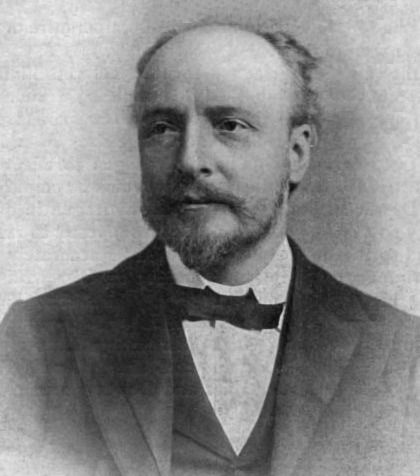
But sometimes it is very easy to know when you have made it big in life. Take Sir James Dewar, for instance. Dewar was a Scottish chemist who did a lot of research into liquefying gases i.e. turning gases into liquids. If you've ever used a propane tank, you are using the liquid form of Propane gas. He was the first person to liquefy Oxygen and Nitrogen. Pretty big deal. So big of a deal, in fact, that folks at his college (Cambridge) composed this nifty little verse when he was still alive:


Sir James Dewar
He is a better man than you are
None of you asses
Can liquefy gases


I mean the dude is clearly important because he has a sir attached to his name. But having a verse composed about your efforts? That's unbeatable. 

Bow down, Babylon:

Sunday, December 12, 2010

Stuck on a problem you can't solve? Try the Feynman algorithm

All of us, at some point or another, have found ourselves stuck while working on a difficult (or not-so difficult) problem. We all have different methods of coping with us. Some of us wallow in self-pity and despair; others bang their heads against the wall. Yet others go drown themselves in beer and Guinness.

Well people, fear not. Cast away your untrained, untested crude methods because I have here a sure-fire approach to problem-solving, patented and endorsed by none other than legendary physicist Richard Feynman .

Dick Feynman was an absolute beast at physics, but it is reputation outside of physics that made him into the larger-than-life figure he is today. Feynman defied the stereotype of the boring, awkward physics professor and exuded charisma and unbeatable energy. He played the bongo drums, enthusiastically took part in student plays at Caltech, cracked safes during the Manhattan project in Los Alamos, and drove around in a van with Feynman diagrams scrawled all over it. Oh and he won the Nobel prize in physics. Pretty damn good, I'd say.

Anyway, here is the time-tested Feynman algorithm you should all use whenever you need help. Just three easy steps:


 1. Write down the problem. Very critical step. If you don't know the problem, how the hell are you going to know what to solve, right?
2. Think really hard. And I mean really really hard.
3. Write down the solution. Voila! You are done! Not too shabby.

Now there used to be a variation of this algorithm that went like this:

1. Write down the problem.

2. Let Dick Feynman solve it.

3. Copy the solution.

Unfortunately since Feyman passed away in 1988, we can't use this anymore.

[The tongue-in-cheek Feynman algorithm was described by fellow Caltech physicist Murray Gell-Mann , a legend and a Nobel laureate in his own right. The Gell-Mann - Feynman rivalry during the 1960's riveted the physics community. It was like the Jersey Shore of their time.]

Here is an example of shenanigans Feynman was known for:

Wednesday, December 8, 2010

Sayonara, goodbye and so long

What has two thumbs and just got out of the last o-chem final of its life? This guy! The last organic chemistry class/lab/instructional yada yada of my life. Done. No more. Clearly, a very poignant moment. So poignant, in fact, that I am going to take a break (no literally, I will make a line break here) to symbolize this sublime moment.


Although I like organic chemistry (a lot), I think O-chem labs are a complete waste of time, effort and talent. They are very shoddy, shabby and hilariously dumbed down. Dichloromethane? Oh no no no undergrads you can't use that! DMSO? Too expensive to let klutzy undergrads handle it!

As a result, we don't end up learning anything useful (as opposed to just the o-chem class where there is some good theory to learn). It becomes a chore to do lab reports and I can't even describe how absurd it is to "reference"  your professor's own course reader when writing up a post-lab. We are obviously writing Nature caliber reports here, right?

Our professor was actually a very nice guy (which made the class oh-so slightly tolerable) and was pretty generous in holding office hours, review sessions, and so on. But that's not enough to overcome the mind-numbing drudgery of decoding noisy IR spectra and hustling in line to get to the reactant first. A freakin' rat race in lab every week!

It's not like this is a sour-grapes type post because I am actually pretty good at o-chem and really enjoyed my normal o-chem classes. I am merely allergic to mindless labor that is not going to lead anywhere anytime soon, and writing endless pre-lab reports comes under this category. If this wasn't a requirement for medical school, I would never have taken an o-chem lab. Would I have taken an o-chem class? Yes. It is a lot like calculus and I love me some calculus on a fine day...

Monday, December 6, 2010

Whacky statistics

It's finals week here so my roommate and I are finding creative ways to deal with the humdrum of studying for exams. Now he is taking a statistics class this quarter, which surprisingly gave him some great ammo for some lame jokes (if you haven't figured it out yet, I am a sucker for lame jokes).

We (mostly he) put our talents to good use and came up with some very outrageous statistical predictions: (Just a fair bit of warning: using these will likely lead to you instantly flunking out of Stats):
  • People who wear sweaters are more likely to fall sick. How so? Well, think about it: when do people wear sweaters the most? Winter. And when do they fall sick the most? Winter. Aha!

  • People who hire lawyers are more likely to go to jail. 

  • People who fly are more likely to get medical school interviews.

  • People who read are more likely to read.

Oh and get ready for the "Game of the century" of the season as the Jets and Patriots clash tonight. 

Tuesday, October 19, 2010

Goodbye to a great mathematician

A couple days ago, I read that famous mathematician Benoit Mandelbrot passed away. If you are not a math nerd or a math hobbyist, you probably have never heard of him before. If you are, however, interested in the fascinating aspects of weird geometries and crazy sequences, you probably worship the man. He is credited with inventing fractal geometry, a branch of mathematics that deals with fractals. I will try my best to go briefly over them, but forgive me if I am not able to clearly explain the idea.

In my precalculus class in high school, there were some forbidden (i.e. chapters we were not going to cover in the class) chapters at the back of the book. One day, I flipped through some of them just out of curiosity. I felt a lot like Harry Potter stealthily walking around the forbidden forest. One of these forbidden chapters talked about something called fractals. This intrigued me a lot. I knew what fractions were (thanks to my third grade math teacher), but what kind of  a beast was this fractal?

I talked to my math teacher and he was nice enough to let me borrow a DVD on fractals. Fractals are, roughly put, geometrical entities that have infinite complexity at all levels of magnification. No matter how far you zoom into the object, you will keep unraveling more and more layers of complexity. The coastline of Britain is often used as an example of this. From the sky, it looks more or less uniform, but as you get closer and closer to it, you begin to see all the jagged edges, coves, etc. They also have a property called self-similarity, which basically means that small sections of a fractal share shape and other features with the fractal as a whole.This video illustrates both of these properties: (it shows the Mandelbrot set, named in honor of the man.)


Fractal geometry has been successfully used to calculate Cloud dynamics, formation of galaxy clusters and predict market fluctuations. Combined with cutting-edge computer technology, fractals have also been used to create stunning visual effects in movies.

Goodbye sir, and thank you for inspiring and captivating us.

Thursday, October 7, 2010

The new aristocracy

Sorry I was AWL for a while there (Away With Leave - it is my blog after all and I don't need leave to leave. Zing!). It was a busy week for me, but things are settling down for now.

Yes folks, it is that time of the year again. A bunch of dignified, boring looking people in black robes will huddle up in an elegant closed room and debate...wait, that's the supreme court. Sorry let me try again. A bunch of dignified, boring looking people will huddle up in an elegant closed room in Sweden (motto: not Norway) to decide the winners of the Nobel prize.

Alfred "dynamite" Nobel bequeathed an enormous sum of money to reward hard-working scientists after he felt enormous remorse at having invented dynamite. So every year the committee sits down and awards prizes in five categories: Physiology or Medicine, Physics, Chemistry, Literature, and Peace. The Nobel prize in economics is a very slight misnomer because it was never specified in Nobel's original will, but was established later by another Swedish dude in memory of Alfred Nobel.

Being a nerd entitles me to obsess over the history and peculiarities of the Nobel prize, and I have proudly done so over the years. Let me share a few today.

  • Like Herbert Hoover's reputation, the Nobel pot has appreciated in value. It is worth some $1.5 million today. Or, roughly what Charlie Sheen makes per episode of Two and a Half Laughs..er Men.
  • Unlike the Oscars (see: Ledger, Heath), the Nobel is never awarded posthumously. As my friend (and roommate) JPA recently said, "Two rules to win a Nobel: Say something controversial and Don't die."
  • The prize cannot be split between more than three people, but the rules of splitting are weird. Some times, one person gets half of the prize money while other two get a quarter of it. A little insulting.

For some (not us), the Nobel is a family affair.

  • William Bragg and Lawrence Bragg are the only father-son duo to share a Nobel Prize. They won in 1915 for their work on X-Ray crystallography. Only 25 at the time, L. Bragg is also the youngest to win the prize. 
  • Niels Bohr, that colossus of early 20th century physics won the prize in 1922. His son Aage matched the old man by winning it in 1975 for his work on refining the model of the nucleus.
  • Arthur Kornberg won the Nobel Prize in Physiology or Medicine in 1959 for discovering DNA Polymerase I. His son Roger won the Chemistry one in 2006 for solving the crystal structure of RNA Polymerase.
All of that pales in comparison to the mercurial Curie family. This superfamily produced three Nobels in all:
  • Marie Curie shared the Physics Nobel in 1903 with her husband Pierre for their work on radiation. She won the 1911 prize in Chemistry for discovering Radium and Polonium. 
  • Pierre and Marie must have done a great job raising their kids because their daughter Irene shared the Nobel in Chemistry with her husband Frederic in 1935 for their work on artificial radioactivity.
ABC take note: this is the real No Ordinary Family.

Winning one Nobel is hard. Winning two is near impossible. And yet there have been several two-peats:

  • Linus Pauling: Pauling virtually created modern chemistry by working on a quantum mechanical model of molecular bond formation and was rightfully awarded the Chemistry prize in 1954. His Peace Nobel (for his work on nuclear nonproliferation) was a bit dubious, in my opinion. Then again, Peace prizes have always been marred by bizarre political overtones. (see: Kissinger, Henry for bringing "lasting peace in Vietnam" and Obama, Barack)
  • As noted above, Marie Curie won it twice.
  • Frederick Sanger: Sanger is the Kobe Bryant of Chemistry. He won it twice, in 1958 and 1980, for his work on protein synthesis and DNA sequencing, respectively.
  • John Bardeen: The Jimmy Neutron, if you will. Bardeen won the Physics prize twice: Transistors (1956), and Superconductivity (1972). Thank him for your ipods and 5 TB harddrives and iFancyMacs.

Friday, August 27, 2010

Of gortex and babkas

You know how sometimes there are words we like so much that we want to keep saying them over and over and over again? William Safire , a noted grammarian who worked as a speechwriter in the Nixon white house and had a popular column in the New York Times Magazine (now that's a contradiction for the books), loved to analyze etymology track trends in word usage and his columns were very insightful and lively. Let's try to do something here too.

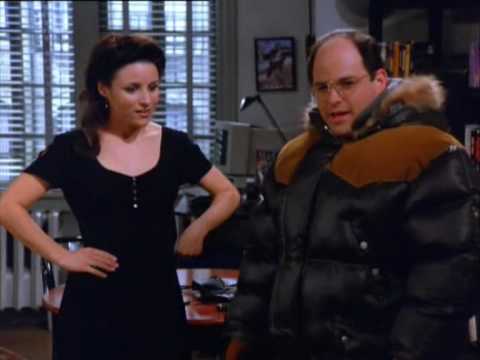
I was watching one of the endless Seinfeld re-runs on TV tonight. It is hellishly cold in New York and George walks into Jerry's apartment wearing a ludicrously puffed up coat which, he proudly and eagerly announces, is made of Gortex "You like saying Gortex, don't ya?", sneers Jerry (when is Jerry not sneering?)And all throughout the episode, George finds excuses to sneak in Gortex in routine conversation.


A bemused Elaine critiquing George's sartorial tastes

Meanwhile, Jerry and Elaine have their own word obsession while waiting in line in a bakery. In a very Seinfeldian manner, they argue whether they should buy a chocolate babka or a cinnamon babka. I am not sure but I think I counted about 15 mentions of bub-kah in less than 3 minutes of screen time.

What is Goretex? Wikipedia, our faithful guide in this complicated world, tells me it was invented by some dude called Gore (not the internet-inventor and world savior Al Gore) in the 1970's. Apparently, it is a breathable and porous fabric used to manufacture raincoats, implants and other assorted junk. It is made of interconnected nodes of Teflon (the same polymer they use to make non-stick pans you cook your foodstuff on). So goretex is essentially a cooking pan that breaths. Splendid.

For his services to humanity, Gore was inducted in the Industrial Inventors Hall of Fame. A Hall of Fame for inventors? Really?! WOW.

Gore and his fellow inventors filed a patent which I was able to dig out from the innards of the interetz: Gortex patent . Remember this kids: you can be rich and famous too if you come up with a fancy polymer that allows you sweat out but doesn't allow the rain to come in.

Don't forget to avoid the eggs, folks. This was a public service announcement from the kind people at UG.